Gentian vs Centaury Bitters: Why a Formula May Include Both
Пост обновлен 21 сентября, 2026
Автор статьи: Daniyar Abdi | LinkedIn
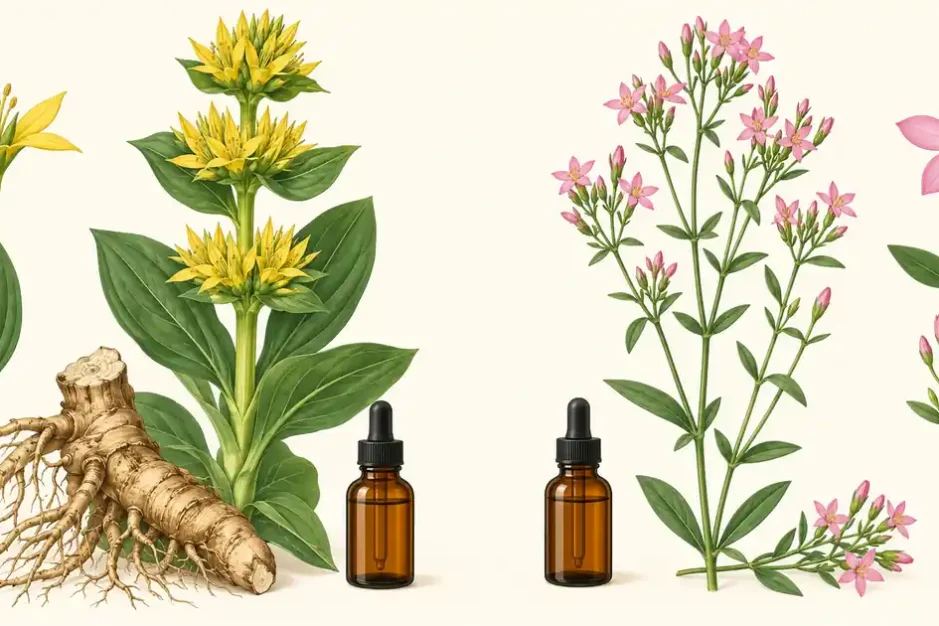
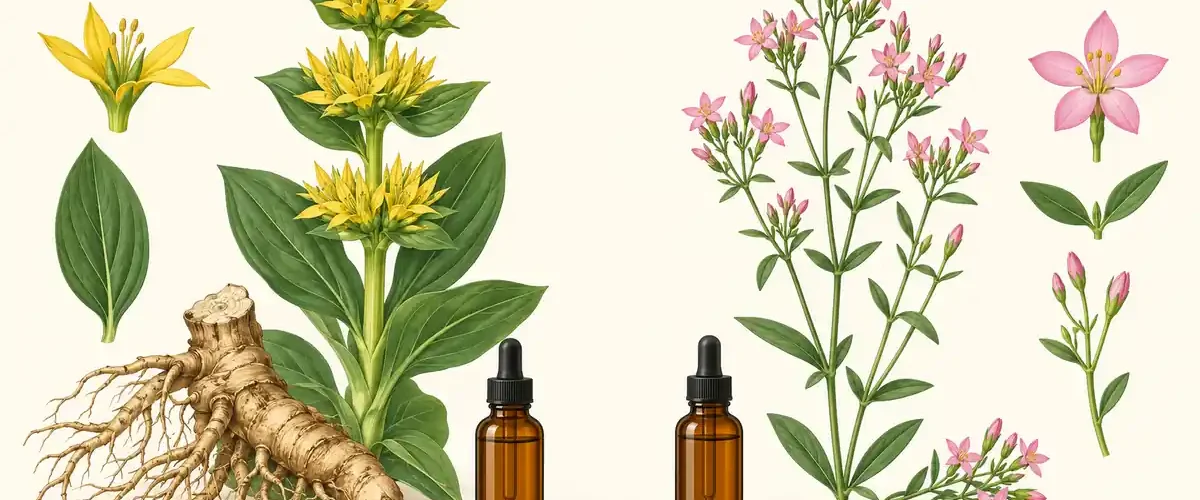
Gentian vs centaury bitters is a useful comparison because the plants share a botanical family and a pronounced bitter taste, yet they are not interchangeable ingredients. Gentian products normally use the root of Gentiana lutea . Centaury products use the flowering aerial parts of Centaurium erythraea . This article explains how to identify each herb, compare tincture labels, and understand why a blend may include both.
HerbEra offers a practical label example because its appetite formula lists gentian root and centaury herb together. Their presence shows a formulation choice, but it does not establish that the combination will produce a specific appetite response.
What is the main difference between gentian and centaury?
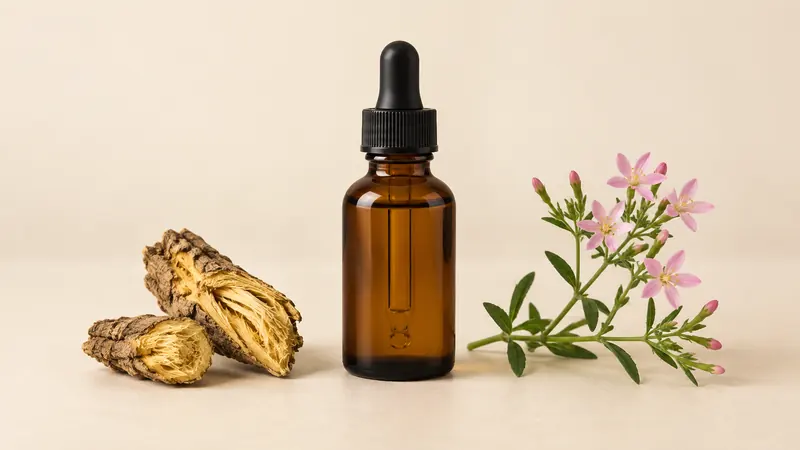
The clearest difference is the plant material. Gentian supplements generally use a thick underground root. Centaury supplements use the dried flowering parts that grow above ground, including stems, leaves, and flowers.
Both species belong to the Gentianaceae family. They also contain bitter secoiridoid compounds. However, they come from different genera, have different constituent patterns, and create distinct sensory profiles. Sharing a plant family does not make them the same botanical ingredient.
| Label feature | Gentian | Centaury |
|---|---|---|
| Accepted botanical name | Gentiana lutea L. | Centaurium erythraea Rafn. |
| Botanical family | Gentianaceae | Gentianaceae |
| Plant part commonly used | Root and rhizome | Flowering aerial parts |
| Typical taste profile | Very strong, deep, and persistent bitterness | Strong, herbaceous bitterness with a lighter plant character |
| Common label terms | Gentian root, yellow gentian, Gentianae radix | Centaury herb, common centaury, Centaurii herba |
| Common supplement formats | Cut root, powder, tea, tincture, liquid extract, dry extract | Cut herb, powder, tea, tincture, liquid extract, dry extract |
| Notable bitter constituents | Gentiopicroside and amarogentin | Swertiamarin, gentiopicroside, sweroside, and centapicrin |
Why might a multi-herb formula contain both?
A formulator may combine gentian and centaury to create a broader bitter flavor rather than relying on one plant. Gentian root can provide deep and persistent bitterness. Centaury herb can add a more herbaceous bitter layer. This is a sensory and formulation explanation, not proof of a stronger clinical outcome.
Different plant matrices
A root and a flowering aerial herb contain different proportions of plant fibers, carbohydrates, secoiridoids, xanthones, and other constituents. Extraction therefore begins with two distinct raw materials, even when the same solvent is used.
Layered taste
Bitterness is not a single flavor note. Its onset, intensity, persistence, and accompanying aromas can vary. Combining two bitter botanicals gives a formulator more control over the finished tincture’s sensory profile.
Traditional formulation logic
Both herbs have a history of use in European bitter preparations. Their traditional association with pre-meal formulas helps explain why they may appear together. Historical use does not confirm a predictable change in appetite for modern users.
Multi-ingredient positioning
In the HerbEra ingredient list, a dual-bitter appetite tincture combines gentian root and centaury herb with burdock root, fennel seed, dandelion root, dandelion leaf, cayenne pepper, and blessed thistle leaf. The complete formula contains eight botanicals and no wormwood. A reader should evaluate the full blend rather than attribute its positioning to gentian or centaury alone.
Does using two bitter herbs make a tincture stronger?
Not necessarily. Two bitter ingredients may create a more complex taste, but ingredient count does not measure concentration or expected effect. A formula could contain a small amount of each herb, a larger amount of one herb, or an undisclosed proprietary ratio.
The word strong can also refer to different qualities:
- Taste strength: how intensely bitter the liquid tastes.
- Extract concentration: the relationship between starting herb and finished extract.
- Serving amount: the quantity listed for one labeled serving.
- Standardization: a declared level of a measured constituent.
- Clinical effect: an outcome that requires appropriate human evidence.
These meanings should not be combined. A highly bitter taste does not prove a larger serving, higher extract ratio, better quality, or greater appetite effect.
How should you compare gentian and centaury tincture labels?
Compare the botanical identity, plant part, preparation, and amount. Front-label phrases such as herbal bitters or appetite support provide little detail on their own.
Botanical name
Look for Gentiana lutea when buying yellow gentian root and Centaurium erythraea when buying common centaury. The word gentian can refer to multiple species, while common names for centaury may vary by market.
Plant part
A clear gentian label should identify root or root and rhizome. A centaury label may say herb, aerial parts, or flowering aerial parts. Centaury root is not equivalent to the customary flowering herb material.
Extract format
Determine whether the product contains powdered herb, a liquid extract, a tincture, or a dried extract. These formats cannot be compared by milligrams alone without more information about the starting material and concentration.
Solvent and extract ratio
Liquid products may use alcohol, water, glycerin, or a combination. An extract ratio such as 1:5 describes the relationship between starting plant material and finished liquid. It does not show that one product will produce a greater appetite response.
Amount per serving
Check whether the Supplement Facts panel states an individual amount for each botanical. A proprietary blend may list only the total blend weight. That makes direct comparisons less precise.
What does bitter value mean?
Bitter value is a sensory or compendial measurement used to describe detectable bitterness under defined conditions. It can help characterize botanical material, but it is not a clinical potency score.
Gentian root contains gentiopicroside and smaller amounts of the intensely bitter compound amarogentin. Centaury contains swertiamarin as a major characteristic bitter constituent, along with gentiopicroside, sweroside, and other secoiridoids. Natural levels vary with species, plant part, harvest conditions, and preparation.
A product label rarely provides enough information to calculate how these compounds compare in the finished serving. Taste can confirm that a formula is bitter, but it cannot verify species identity, purity, constituent levels, or suitability.
Gentian and Centaury Label Checklist
Use this checklist when comparing a single-herb extract with a multi-herb bitter formula. It focuses on information that can be verified from the label. It does not predict an individual appetite response.
- Confirm the species
Look for the full botanical name. Avoid relying only on gentian, centaury, or bitters on the front panel.
- Match the plant part
Expect root or root and rhizome for gentian. Expect flowering aerial parts or herb for centaury.
- Identify the format
Note whether the product uses powder, tincture, glycerite, liquid extract, or dried extract. Do not assume equal amounts across formats.
- Find the solvent
Check for alcohol, glycerin, water, or a mixed solvent. The solvent helps describe the preparation but does not guarantee superiority.
- Check the extract ratio
Record any ratio and determine whether it refers to the individual herb or the whole blend. Do not convert it directly into clinical potency.
- Review serving transparency
Look for individual botanical amounts. If only a total blend amount appears, the exact proportion of each herb remains unknown.
- Read all warnings
Follow age restrictions, pregnancy guidance, allergy notices, medication cautions, and storage directions printed on the product.
What safety points matter with strong bitter formulas?
Botanical identity and personal suitability both matter. Concentrated liquid extracts can produce an intense taste and may cause unwanted gastrointestinal sensations in some users. Products may also contain alcohol or other ingredients that affect suitability.
Ask a qualified healthcare professional before use if you are pregnant, breastfeeding, taking medication, preparing for surgery, or managing a health condition. Seek professional assessment for persistent appetite changes or unexplained weight changes rather than relying on a bitter formula.
No. Gentian is usually Gentiana lutea root, while centaury is usually the flowering aerial herb of Centaurium erythraea.
Yes. Both belong to Gentianaceae, but they come from different genera and use different plant parts.
Both are strongly bitter. Gentian root is commonly described as especially strong and persistent, while centaury has a more herbaceous bitter profile.
A formulator may combine them for a layered taste, different plant matrices, and traditional formulation logic. Their combination does not prove a stronger outcome.
Not on a one-to-one basis. They differ in species, plant part, constituent pattern, taste, and extraction behavior.
No. Taste does not confirm identity, purity, concentration, testing, or label accuracy.
Glossary
Aerial parts
The portions of a plant that grow above ground, commonly including stems, leaves, and flowers.
Botanical name
A standardized Latin name used to identify a plant species more precisely than a common name.
Bitter value
A measurement used to characterize detectable bitterness under specified conditions.
Gentianae radix
The Latin herbal term for gentian root.
Centaurii herba
The Latin herbal term for centaury herb, usually the flowering aerial parts.
Secoiridoid
A class of plant compounds that includes several characteristic bitter constituents in gentian and centaury.
Extract ratio
The stated relationship between the quantity of starting botanical material and the resulting extract.
Proprietary blend
A mixture that may disclose its total weight without stating the amount of every individual ingredient.
Conclusion
Gentian root and centaury herb provide different botanical materials and bitter profiles within the same plant family. A formula may contain both for sensory and formulation reasons, but the pairing does not establish a predictable appetite effect.
Sources Used
European Union herbal monograph on Gentiana lutea root — ema.europa.eu/en/documents/herbal-monograph/european-herbal-monograph-gentiana-lutea-l-radix-revision-1_en.pdf
Assessment report on Gentiana lutea root — ema.europa.eu/en/documents/herbal-report/assessment-report-gentiana-lutea-l-radix-revision-1_en.pdf
European Union herbal monograph on Centaurium erythraea herb — ema.europa.eu/en/documents/herbal-monograph/european-union-herbal-monograph-centaurium-erythraea-rafn-sl-herba_en.pdf
Assessment report on Centaurium erythraea herb — ema.europa.eu/en/documents/herbal-report/assessment-report-centaurium-erythraea-rafn-sl-herba_en.pdf
Accepted taxonomy for Gentiana lutea — powo.science.kew.org/taxon/368453-1
Accepted taxonomy for Centaurium erythraea — powo.science.kew.org/taxon/326619-2
Читать другие статьи на сайте Скрибо.кз
- Gentian vs Centaury Bitters: Why a Formula May Include Both
- Виртуальный номер Казахстана для звонков и SMS: Voice или Voice+SMS
- Почему сильный текст не продаёт без трафика: как собрать рабочую связку
- Как рассчитать количество мерчандайзеров для 30, 50 или 100 магазинов
- Организация тимбилдинга: главные факторы качественного мероприятия